Firmware architecture
QMK keyboard definition under firmware/qmk/keyboards/x240_pico/, built by copying it
into a QMK checkout. Files marked new are created in milestone M4; the rest exist today
and are corrected there.
| File | Owns | Status |
|---|---|---|
keyboard.json |
USB IDs, processor/bootloader, feature flags, the ps2 block, layout metadata. matrix_pins is removed — the custom matrix owns pins. |
exists, corrected in M4 |
config.h |
Sense chain (SENSE_PL_PIN, SENSE_CHAIN_BYTES, SENSE_SPI_DIVISOR), SPI0 pins (SPI_DRIVER, SPI_SCK_PIN, SPI_MISO_PIN, SPI_MOSI_PIN), MATRIX_DRIVE_PINS, debounce, backlight, power button, LED, SYN_* tuning |
exists, corrected in M4 |
rules.mk |
CUSTOM_MATRIX = lite, POINTING_DEVICE_DRIVER = custom, PS2_ENABLE = yes + PS2_DRIVER = vendor, PS2_MOUSE_ENABLE = no, BACKLIGHT_DRIVER = software, SRC += matrix.c synaptics.c trackpoint.c |
corrected in M4 |
halconf.h / mcuconf.h |
HAL_USE_SPI, RP_SPI_USE_SPI0 — ChibiOS needs SPI0 switched on for the sense chain |
new |
matrix.c |
Drive-line sequencing and the 74HC165 chain read | new |
synaptics.c / .h |
The custom pointing-device driver: ClickPad reset/identify/capabilities, mode byte, guest enable, 6-byte packet parser with resync, touchpad delta, logged relative-mode fallback | new |
trackpoint.c / .h |
Guest (pass-through) frame decode, TrackPoint delta and scaling | new |
x240_pico.c |
keyboard_post_init_kb (LED on, power-button pull-up), matrix_scan_kb (power-button long-press guard), pointing_device_task_kb (pass-through; merge happens in synaptics.c) |
exists |
x240_pico.h |
LAYOUT macro, custom keycodes CK_BKLT/CK_FNLK, layer enum |
exists; LAYOUT regenerated from the measured matrix |
keymaps/default/keymap.c |
_BASE and _FN layers, process_record_user |
exists; regenerated from the measured matrix |
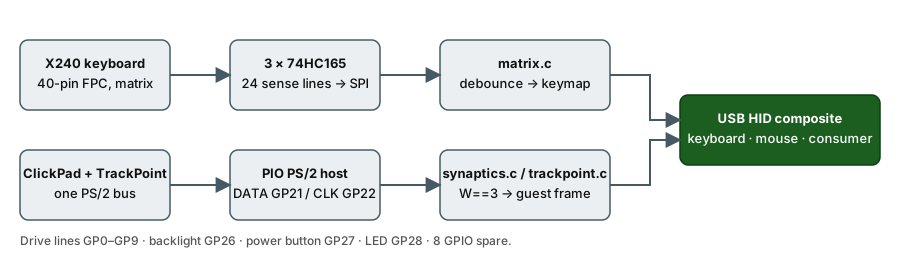
From a key press to a USB report
GP0..GP9 drive line LOW
   → membrane closes a sense line to it
      → 74HC165 latches 24 sense bits (PL)
         → SPI0 clocks them into GP16          matrix.c : matrix_scan_custom()
            → raw row bitmap
               → QMK debounce (DEBOUNCE 5 ms)   quantum/
                  → keymap lookup, layers        keymap.c
                     → NKRO / boot keyboard report over USB (TinyUSB)
From the ClickPad to a USB mouse report
ClickPad + TrackPoint guest  ──PS/2──►  GP21 DATA / GP22 CLK
   → QMK vendor PS/2 driver (RP2040 PIO0)         platforms/chibios/drivers/vendor/RP/RP2040/ps2_vendor.c
      → pbuf_has_data() / ps2_host_recv() bytes
         → synaptics.c (custom pointing driver) assembles 6-byte packets
            ├─ W != 3 : touchpad frame  → finger delta, L/R from byte 0    synaptics.c
            └─ W == 3 : guest frame     → TrackPoint 3-byte packet          trackpoint.c
               → both add into one report_mouse_t inside                    synaptics.c
                 pointing_device_driver_get_report()
                  → pointing_device_task_kb() passes it through              x240_pico.c
                  → USB HID mouse report
If the Synaptics identify fails, synaptics.c falls back to plain relative mode and logs
once via dprintf — the touchpad still works, the TrackPoint does not, and the log says so.
Never a silent success.
Hooks used and why
| Hook | Used for | Not used for |
|---|---|---|
matrix_init_custom / matrix_scan_custom |
the chain | anything else — keep the scan loop minimal |
keyboard_post_init_kb |
LED and power-button GPIO setup | keymap logic |
pointing_device_driver_init |
Synaptics init; failures logged on the console | matrix |
matrix_scan_kb |
power-button timing only | side effects on the matrix |
pointing_device_task_kb |
pass-through only (merge and Y inversion happen in the driver) | pointing logic |
process_record_user |
CK_BKLT, CK_FNLK |
hardware polling |
Build
cp -r firmware/qmk/keyboards/x240_pico ~/qmk_firmware/keyboards/x240_pico
qmk compile -kb x240_pico -km default
qmk flash   -kb x240_pico -km default     # hold BOOTSEL, or Bootmagic top-left key
Local build without installing a toolchain: the qmkfm/qmk_cli docker image plus a
qmk_firmware checkout, with this directory mounted at keyboards/x240_pico. The
placeholder LAYOUT still describes the old 8 × 13 arrangement inside the 10 × 24 matrix;
issue #38 regenerates it from the measured pinout.